Showing posts with label Fauna. Show all posts

Italy’s most threatened animal species include the Marsican brown bear, European eel, Adriatic sturgeon, and Mediterranean monk seal — all facing critical risk due to habitat loss, pollution, and human activity.

Key Species at Risk in Italy

Here are some of the most endangered animals identified by the IUCN Red List for Italian vertebrates and recent conservation reports:

Species
Status (IUCN)
Habitat
Main Threats

Marsican brown bear (Ursus arctos marsicanus)
Critically Endangered
Central Apennines
Habitat fragmentation, poaching, low population (~50 individuals)

European eel (Anguilla anguilla)
Critically Endangered
Rivers, lakes, Mediterranean
Overfishing, pollution, dams blocking migration

Adriatic sturgeon (Acipenser naccarii)
Critically Endangered
Po River basin
Overfishing, habitat degradation, water pollution

Mediterranean monk seal (Monachus monachus)
Endangered
Mediterranean coasts
Tourism disturbance, fishing nets, habitat loss

Italian cave salamander (Speleomantes italicus)
Endangered
Apennine caves
Habitat destruction, climate change

Common dolphin (Delphinus delphis)
Endangered
Mediterranean Sea
Bycatch, pollution, decline in prey fish

Griffon vulture (Gyps fulvus)
Near Threatened
Sardinia, Abruzzo
Poisoning, habitat loss

Zelkova sicula (tree, but important)
Critically Endangered
Sicily
Extremely restricted range, climate change

Sources: IUCN Italian Red List, Managaia report on endangered Italian speciesmanagaia.eco, Flora Fauna Fun endangered species list.

Why These Species Are Disappearing

  • Habitat loss & fragmentation: Urbanization, roads, and agriculture reduce viable living space.

  • Pollution & climate change: Rivers and seas are heavily impacted by industrial waste and warming waters.

  • Overexploitation: Fishing and hunting pressure remain high for species like sturgeon and eel.

  • Small populations: Some species, like the Marsican bear, have dangerously low numbers, making them vulnerable to disease or accidents.

⚠️ Risks & Conservation Challenges

  • Genetic bottlenecks: Tiny populations risk inbreeding and reduced resilience.

  • Human conflict: Bears and wolves often clash with farmers, leading to illegal killings.

  • Tourism pressure: Monk seals and dolphins are disturbed by boats and coastal development.

  • Weak enforcement: Protective laws exist but are inconsistently applied.

Conservation Efforts

  • Protected areas: National parks (Abruzzo, Gran Paradiso) safeguard habitats.

  • Reintroduction programs: Vultures and sturgeons are being bred and released.

  • EU directives: Italy follows Natura 2000 and Habitats Directive for species protection.

  • Awareness campaigns: NGOs highlight biodiversity loss to push for stronger policies.

Italy’s biodiversity is rich but fragile. Protecting these species means balancing human development with ecological preservation. I

0

The village of Castelbuono extends gently between valleys and hills a few kilometers from the Tyrrhenian Sea , immersed in the luxuriant landscape of the Madonie . The fortune of the town is due to the Ventimiglia family who settled there in 1316 building the castle , still today the fulcrum and symbol of Castelbuono. 

Today used as a Civic Museum , it hosts in the space in front, in August, “l'Aruccata di li Ventimiglia” , a costume party that commemorates the family of the same name.

Today used as a Civic Museum , it hosts in the space in front, in August, “l'Aruccata di li Ventimiglia” , a costume party that commemorates the family of the same name.

 Castelbuono with its oak and ash woods.

The urban expansion has found an important element in the axis that connects the castle to Piazza Margherita , the heart of the town, where there is a sixteenth-century fountain and the church called Matrice Vecchia.

The castle.

The castle is imposing with its square plan and corner towers and inside the Palatine Chapel is decorated with stuccoes executed in 1683 by the brothers Giuseppe and Giacomo Serpotta as well as the silver urn that contains the relics of the patron saint of Castelbuono, Sant ' Anna .
Castelbuono

The church.

Built in the 14th-15th century on the site of a pagan temple and dedicated to the Assumption , with four naves, the church is characterized on the outside by a beautiful Renaissance portico and a massive bell tower.

Inside, the grandiose polyptych of 1520 attributed to Pietro Ruzzolone and the numerous frescoes including the fourteenth-century ones depicting the Consecration of the Virgins are to be admired .

The Naturalistic Museum.

The Francesco Minà Palumbo Naturalistic Museum is housed in the former convent of Santa Venera and boasts important collections including minerals, fossils and a herbarium that collects the entire spontaneous flora of the Madonie .

Continuing on Via Umberto I you arrive at the church called Matrice Nuova , built in the seventeenth century and rebuilt following the damage of the earthquake of the early nineteenth century and rich in stucco.

From here you go up towards the late medieval church of San Francesco, remodelled in the 18th century, to arrive at the 16th century church of the Capuchin convent, inside which there are precious wooden sculptures and paintings from the 17th century.

The church dates back to the 14th century. The restorations have brought to light some elements of a previous construction of the thirteenth century. 

The building has undergone several alterations over time and currently mixes the Roman-Gothic, Catalan Gothic and Composite-Chiaramonte styles.

Finally, the adjoining library contains important ancient texts such as a collection of local natural history, with 500 tables depicting plants and birds.

2

Woods and green pine forests , a rich flora and fauna population, fresh and brackish water valleys and rivers that flow into the Adriatic: these are some of the tiles that make up the extraordinary mosaic of the Po Delta , a magnificent example of biodiversity, in where water has been the absolute protagonist for centuries.

Here, where the earth and the sky merge, there are seductive naturalistic treasures like few others exist in the world, so unique that they were designated in 1999 a World Heritage Site in 1999 . Two parks protect this wonderful naturalistic area which extends over an area of ​​over 66,000 hectares, covering two regions . 

A labyrinth of landscape possibilities that includes the Veneto Regional Park on one side, north of the great river Po; on the other, towards the south, the Regional Park of Emilia Romagna. 
 

Po Delta Park One.

Anyone is surprised by the great variety of environments and cultural attractions that this area can offer. 

The relics of the primitive Mediterranean scrub, the hygrophilous wood, the coastal lagoons, the brackish valleys and the wetlands of fresh water that mix with the ancient remains of settlements can be found side by side, without interruption. 

Etruscans and Romans, Byzantine mosaics and the suggestions of Benedictine and Este architecture. 

The Po Delta in the Ferrara area Woods reminiscent of dark woods where deer roam majestic ( Bosco della Mesola ), flamingos and cormorants surrounded by reeds that walk in the fog between low brackish lagoons, small fishing villages linked to the collection of clams or eels ( Goro and Comacchio ). From the river Po to the valleys of Comacchio this is the landscape that presents itself to those who visit the Ferrara part of the Delta. 

 The possible itineraries.

The possible itineraries are infinite and the amazement that accompanies them is indescribable. The same one you feel when you come across the monumental Pomposa abbey or one of the many Este Delights (such as that of Belriguardo in Voghiera , Del Verginese in Portomaggiore and that of the Mesola castle ), traces of a past splendor hovering between nature, harmony and beauty. The Po Delta in the Ravenna area The Ravenna part of the Park reaches to the south of the Comacchio Valleys, and from here opens up, with pine forests and planks , to fascinating natural areas and sites of cultural interest such as the basilica of Sant'Apollinare in Classe , a Unesco monument since 1996 . 

There are silent valleys stretching out towards the sea where specimens of vegetation grow and rare fauna species reside, the Oasis of Boscoforte and Punte Alberete , the centuries-old pine forests of San Vitale and Classe sung by Dante and Boccaccio and, finally, further down we arrive at the ancient saline di Cervia , a favorite place for flocks of pink flamingos.

 The environment and the landscapes.

Despite the heavy intervention of man over the centuries, starting from the sea and entering the hinterland, there are many different habitats.

There are the plants of the dunes and the sands, the ancient wooded areas (such as the Mesola Wood), the coastal pine forests and the submerged woods, but also ash trees, willows, poplars and aquatic species such as the white water lily or the common reed marsh.

However, it is above all from the faunal point of view that this area surprises. Well over 300 species of birds have chosen this territory as their resting and breeding area. 

A unique ecosystem where cormorants, coral gulls and terns return to nest every year. Alongside the birds, on the golden beaches, among the reeds, the lagoons and the valleys, you can spot fallow deer, deer , small mammals, as well as amphibians, sturgeons and eels. 

 What to do.

On foot, by boat, by bicycle or on horseback : according to the different seasons there are many ways to experience this particular natural ecosystem in a slow mode, nestled between the beauty of three cities of art such as Ravenna, Ferrara and Venice. 

The numerous bird species have transformed the area into an area with a strong appeal for all birdwatchers with specific itineraries , equipped areas and observation sites, as well as an international festival (Birdwatching Fair). 

Visiting the Delta Park means having the opportunity to confront and establish, far from the chaos of inhabited centers, a direct contact with the culture, local traditions and gastronomic specialties of a land that has always been on the "margins". 

 Events such as the Slow Spring - which are repeated every year from March to June - help lovers of the outdoors to deal with the Delta area in the name of slow and sustainable tourism. The best advice is to refer to the visitor centers scattered throughout the area ( Alfonsine , Argenta , Cervia , Comacchio , Massenzatica, Mesola , Ostellato , Sant'Alberto and Savio) to obtain all the useful information to fully enjoy a dream holiday. 


2

The Alta Murgia welcomes a fauna among the most interesting of Puglia and Italy, with widely distributed species tied to steppe environments and a few species distribution point linked to other environments. 


Among the birds that populates the Murgia there are some of the most important populations of species of steppe and semiarid areas of the Mediterranean basin: lark (Calandrella brachydactyla) and the calender (Melanocorypha calender) that have particular relevance for the purposes conservazionistici being the most numerous populations Italian peninsula, woodlark (Lullula arborea ), skylark (Alauda arvensis), crested lark (Cristata Gallery), stone curlew (Burhinus oedicnemus ). 

The animals of the Alta Murgia National Park.

 Contributing to the beauty of the landscapes is a wide variety of flowers made up of oaks, cypresses and Aleppo pines. On the natural meadows you can see olive trees (wild olive trees), medlar and almond trees. 

The steppe area, on the other hand, hosts several species of orchids, together with dog roses. Lots of animals that can be found on the vast area of the Apulian park. 

First of all the birds, particularly present with different species of hawks including the peregrine, the lesser kestrel and the lanner, but also with a few specimens of gray heron. 

There is also no shortage of nocturnal birds: after sunset you can see and hear barn owls, tawny owls, owls and owls here.

Birds.


The Murgia welcomes several species of birds of prey including one of the largest populations in the world of lesser kestrel (Falco naumanni ), a priority species for which the steppe is the trophic habitats and nesting in the historical centers of the neighboring countries where it determines a match unique among ancient architecture and nature. Other species of birds of prey of great importance in the area are the red kite ( Milvus milvus ), the short-toed ( Circaetus gallicus ), the Montagu's harrier ( Circus pygargus ), the marsh harrier ( Circus aeroginosus ), buzzards (Buteo buteo), The kestrel ( Falco tinninculus ), and the Lanner falcon ( Falco biarmicus feldeggii ) for which southern Italy is the western limit expansion. 

Among the owls are the barn owl ( Tyto alba ), the long-eared owl ( Asio otus ) and the owl ( Athene noctua ). 

Amphibians.

The Murgia is also the habitat of amphibians such as the Italian newt ( Triturus italicus ), endemism of central and southern Italy, and the yellow-bellied toad ( Bombina pachypus ) and reptiles such as geckos of kotschyi ( cyrtopodion kotschyi ) , the green lizard ( Lacerta bilineata ), the cervone (Elaphe quatuorlineata ), the leopard snake ( Elaphe situla ), the viper ( Vipera aspis ) and the Hermann tortoise ( Testudo hermanni ). 

Mammals.

Among the mammals to be counted the fox ( Vulpes vulpes ), the weasel ( Mustela nivalis ), marten ( Martes weasel ), the badger ( Meles meles ) sporadically is also the wolf ( Canis lupus ).

Of great importance is the small mammal population as the main source trophic for many birds of prey, including the shrew ( Suncus etruscus ), Savi's vole ( Pitymis lizards ), the wood mouse (Apodemus sylvaticus ) and the numerous species of bats of which he cites the greater horseshoe ( greater horseshoe bat ), the lesser horseshoe ( Rhinolophus hipposideros ), the Mediterranean horseshoe ( Rhinolophus euryale ), the Miniottero ( Miniopterus schreibersi ), the greater vespertilio ( Myotis myotis ), the vespertilio Blyth ( Myotis blythii ).

2

Campania  is a region in Southern Italy. The region at the end of 2014 had a population of around 5,869,000 people, making it the third-most-populous region of Italy; its total area of 13,590 km2 (5,247 sq mi) makes it the most densely populated region in the country.

Located on the Italian Peninsula, with the Mediterranean Sea to the west, it includes the small Phlegraean Islands and Capri for administration as part of the region.

Campania was colonised by Ancient Greeks and was part of Magna Græcia. During the Roman era, the area maintained a Greco-Roman culture. The capital city of Campania is Naples. Campania is rich in culture, especially in regard to gastronomy, music, architecture, archeological and ancient sites such as Pompeii, Herculaneum, Paestum and Velia. 

Campania, a magical land.

The name of Campania itself is derived from Latin, as the Romans knew the region as Campania felix, which translates into English as "fertile countryside". 

The rich natural sights of Campania make it highly important in the tourism industry, especially along the Amalfi Coast, Mount Vesuvius and the island of Capri.campania-capri

Discover Italy: Campania.

The original inhabitants of Campania were three defined groups of the Ancient peoples of Italy, who all spoke the Oscan language, which is part of the Italic family; their names were the Osci, the Aurunci and the Ausones.

During the 8th century BC, people from Euboea in Greece, known as Cumaeans, began to establish colonies in the area roughly around the modern day province of Naples.

Another Oscan tribe, the Samnites, moved down from central Italy into Campania. Since the Samnites were more warlike than the Campanians, they easily took over the cities of Capua and Cumae, in an area which was one of the most prosperous and fertile in the Italian Peninsula at the time.

During the 340s BC, the Samnites were engaged in a war with the Roman Republic in a dispute known as the Samnite Wars, with the Romans securing rich pastures of northern Campania during the First Samnite War.

The major remaining independent Greek settlement was Neapolis, and when the town was eventually captured by the Samnites, the Neapolitans were left with no other option than to call on the Romans, with whom they established an alliance, setting off the Second Samnite War.

The Roman consul Quintus Publilius Filo recaptured Neapolis by 326 BC and allowed it to remain a Greek city with some autonomy as a civitas foederata while strongly aligned with Rome.

The Second Samnite War ended with the Romans controlling southern Campania and additional regions further to the south

Geography.

Campania has an area of 13,590 km2 (5,247 sq mi) and a coastline of 350 km (217 mi) on the Tyrrhenian Sea. Campania is famous for its gulfs (Naples, Salerno and Policastro) as well as for three islands (Capri, Ischia and Procida).

Four other regions border Campania; Lazio to the northwest, Molise to the north, Apulia (Puglia) to the northeast and Basilicata to the east.

The mountainous interior is fragmented into several massifs, rarely reaching 2,000 metres (Miletto of 2,050 m), whereas close to the coast there are volcanic massifs: Vesuvio (1,277 m) and Campi Flegrei.

The climate is typically Mediterranean along the coast, whereas in the inner zones it is more continental, with low temperatures in winter. 51% of the total area is hilly, 34% mountainous and the remaining 15% is made up of plains. There is a high seismic risk in the area of the region.

Read also: Italian biodiversity, the reasons for biological wealth and the causes of its reduction.

Ancient, medieval, and early arts.

The region of Campania is rich with a vast array of culture and history. Since the Greek colony of Elea, now Velia, Campania was home to philosophers of the Pre-Socratic philosophy school, such as Parmenides and Zeno of Elea, who came to prominence around 490–480 BC.

The Latin poet Vergil (70 BC–19 BC) settled in Naples in his late life: parts of his epic poem Aeneid are located in Campania. The ancient scientist Pliny the Elder studied Mount Vesuvius, and died after being poisoned and killed by gas emitted from the volcano during the 79 AD eruption.

Discover Italia: off the beaten path, wine and food itineraries and naturalistic routes.Click to Tweet

Contemporary and modern arts.

The so-called "School of Posillipo" and "School of Resina", dating from the late 19th to early 20th centuries, included painters such as Giacinto Gigante, Federico Cortese, Domenico Morelli, Saverio Altamura, Giuseppe De Nittis, Vincenzo Gemito, Antonio Mancini, Raffaello Pagliaccetti.

Amongst the painters who inspired directly these schools, are Salvator Rosa, Pierre Jacques-Antoine Volaire, Anton Sminck van Pitloo who spent his last years in Naples. Opera singer Enrico Caruso was also a native of Naples. Russian revolutionary leader Vladimir Lenin lived for a period in Capri. In the 20th century, the music genre called Neapolitan song became popular worldwide, with songs such as "O sole mio", "Funiculì, funiculà", "O surdato nnamurato", "Torna a Surriento", "Guapparia, "Santa Lucia", "Reginella", "Marechiaro", "Spingule Francese".


Cuisine.

Campanian cuisine varies within the region. While Neapolitan dishes centre on seafood, Casertan and Aversan ones rely more on fresh vegetables and cheeses. The cuisine from Sorrento combines the culinary traditions from both Naples and Salerno.
Pizza was conceived in Naples.

Spaghetti is also a well-known dish from southern Italy and Campania.


Pasta_Puttanesca
pizza-margherita_sep2005_sml
2
Italy counts 22 national parks covering an overall surface of 1 million ha, corresponding to 5% of national territory. Furthermore, 50 Italian sites have been recognized as internationally relevant wetlands worth to be included in the Ramsar Convention on Wetlands' list. Areas included in Nature 2000 Network cover 20.5% of the national surface.

The Italian forests are very important for the landscape, the biodiversity, the balance of the environment, and for the economy. It occupies about 10 millions of hectares (30% of national area) and represents 5% of total European forested area. This forested area was gradually increased, at a rate of about 100,000 hectares per year, in the period 2000-2005 through a progressive change from agriculture land use form.


Biodiversity Italy, Biodiversity in numbers.

Around the Italian peninsula 23 protected marine areas and 2 marine parks safeguard about 200432 ha of sea and more than 700 km of coastline.

Vulnerabilities - Marine, estuarine and intertidal biodiversity.


The combined action of anthropic effects and climate change negatively affects the entire ecosystem, causing seashore regression and decrease of marine life.


Vulnerabilities - Freshwater ecosystems.

Italian biodiversity, the reasons for biological wealth and the causes of its reduction.Click to Tweet

Freshwater ecosystems are expected to experience alterations, like:

phenology changes, northward movements and development of invasive alien species, leading to reduced species richness, which could represent a special vulnerability in Alpine freshwater ecosystems;

salt water intrusion into coastal fresh-water beds and loss of wetlands, causing severe imbalances in the wetlands of the coastal zone with changes in salinity and hence in the related biotic communities.

The Mediterranean ecohydrology is vulnerable to climate change, and can affect flora and fauna of the region. In arid and semi-arid parts of the region, the biggest danger facing the lakes is the expected decrease in water input resulting from increasing evapotranspiration with increasing temperature and decreasing precipitation. This process can lead to conversion of existing freshwater to saltwater.

Glacier-fed rivers.


As a result of the apparent `low' biodiversity, and minimal knowledge regarding the distribution of alpine aquatic species, glacier-fed rivers have received negligible attention from conservationists (10). The rapid shrinking of glaciers results in a reduction in glacial meltwater contribution to river flow in many glacierized catchments. These changes potentially affect the biodiversity of specialized glacier-fed river communities.

Research has shown that 11–38% of the regional species pools in study regions in Ecuador, the Alps and Alaska, including endemics, can be expected to be lost following complete disappearance of glaciers in a catchment, and steady shrinkage is likely to reduce local richness at downstream reaches where glacial cover in the catchment is less than 5–30. Extinction will probably greatly exceed the few known endemic species in glacier-fed rivers.

Read also: Italy is considered the birthplace of Western civilization and a cultural superpower.

Vulnerabilities - Terrestrial biodiversity.


The Paris Agreement of December 2015 aims to maintain the global average warming well below 2°C above the preindustrial level. Ecosystem variability during the past 10,000 years was reconstructed from pollen analysis. Only a 1.5°C warming scenario permits Mediterranean land ecosystems to remain within this Holocene variability. At or above 2°C of warming, climatic change will generate land ecosystem changes that are unmatched in the Holocene.


In fact, regional temperatures in the Mediterranean basin are now ~1.3°C higher than during 1880-1920, compared with an increase of ~0.85°C worldwide. Climate model projections indicate that the projected warming in the Mediterranean basin this century continues to exceed the global trend. Without ambitious mitigation policies anthropogenic climate change will likely alter ecosystems in the Mediterranean this century in a way that is without precedent during the past 10,000 years. The highly ambitious low-end scenario of climate change (the so-called RCP2.6 scenario) seems to be the only possible pathway toward more limited impacts. Under a high-end scenario of climate change (the RCP8.5 scenario), all of southern Spain turns into desert, deciduous forests invade most of the mountains, and Mediterranean vegetation replaces most of the deciduous forests in a large part of the Mediterranean basin.


In addition to climate change, other human impacts affect ecosystems, such as land-use change, urbanization, and soil degradation. Many of these effects are likely to become even stronger in the future because of the expanding human population and economic activity. Without ambitious climate targets, the potential for future managed or unmanaged ecosystems to host biodiversity or deliver services to society is likely to be greatly reduced by climate change and direct local effects (23).

Climate change projections suggest that the share of stable plant species in 2100, compared with 1990, might range between 60-80% in northern Italy and Apennines, 20-40% in the Mediterranean area, and 40-60% in southern Italy.

Vulnerabilities - Alpine regions and mountain ecosystems.


Mountain ecosystems are particularly vulnerable to climate change. The following major impacts are expected:

exceptional warming in Alpine zones, especially during summer and at high altitudes, and particularly for western Alps;

increasing intensity and frequency of precipitation events (rainfall) in winter and decreasing in summer;

possible significant changes in the structure of mountain plant communities induced by a 1-2 °C temperature increase;

shift of plant and animal species towards higher elevations - the upward and northward movements of ecosystems induced by temperature increase could involve a potential increase in animal and plant species richness in the Alps, assuming that movements through habitats are possible; however, such shifts generally put mountain flora and fauna at high risk of extinction (8);

glaciers retreat and permafrost reduction - small glaciers are expected to disappear, while larger ones are projected to suffer a volume reduction between 30% and 70% by 2050; the European Alps could lose about 80% of their average ice cover for the period 1971–1990 against a summer air temperatures increase of 3°C, involving nival ecosystem loss.

Extinction debt of high-mountain plants.


The extremes of possible climate-change-driven habitat range size reductions are commonly based on two assumptions: either species instantaneously adapt their ranges to any change in the distribution of suitable sites (`unlimited dispersal' scenario), or they are unable to move beyond the initially occupied sites (`no dispersal' scenario). In addition to these static, niche-based model predictions, a so-called hybrid model was used that couples niche-based projections of geographical habitat shifts with mechanistic simulations of local demography and seed dispersal (based on regional circulation model projections and the A1B climate change scenario).

Averaged across 150 species in the Alps, the hybrid model simulations indicate that by the end of the twenty-first century these high mountain plants will have lost 44-50% of their present alpine habitat ranges under high and low values of demographic and dispersal parameters, respectively.

The hybrid model indicates that the opposing effects of delayed local population extinctions and lagged migration rates will result in less severe twenty-first-century range reductions of alpine plants than expected from static, niche-based model predictions. However, these apparently `optimistic' forecasts include a large proportion of remnant populations under already unsuitable climatic conditions . The persistence of such remnant populations creates an extinction debt that will have to be paid later unless species manage to adapt phenotypically or genetically to the changing climate  and to the likely associated alterations in their biotic environments .

Most importantly, the hybrid model results consistently caution against drawing overoptimistic conclusions from relatively modest range contractions observed during the coming decades, as these are likely to mask more severe longer-term warming effects on mountain plant distribution (.


Benefits from climate change.


An opposite trend caused by the lengthening of the growing period is recorded in central-northern Italy where a forest expansion is observed. Moreover, even if no data regarding forest ecosystem productivity are available, the negative effects determined by deterioration, and the positive effects caused by the lengthening of the growing period can be observed .

Adaptation strategies.


The adaptation capacity of natural systems to climate change will have to be strengthened through the adoption of adaptation measures promoting.


Labels.


BIODIVERSITY.
The Italian forests are very important for the landscape, the biodiversity, the balance of the environment, and for the economy. It occupies about 10 millions of hectares (30% of national area) and represents 5% of total European forested area. This forested area was gradually increased, at a rate of about 100,000 hectares per year, in the period 2000-2005 through a progressive change from agriculture land use form.
Areas included in Nature 2000 Network cover 20.5% of the national surface.

FAUNA.

The Sanctuary includes marine areas within both inland waters and territorial waters (twelve mile zone) of France, Italy and the Principality of Monaco. It also includes the neighbouring high seas. The Italian regions involved are: Liguria, Sardinia and Tuscany.
The portion of basin between Liguria and Provence have been known since the ancient time to be the home for many species of whales and other marine fauna. The protected area accounts for about 100.000 km2.


To find a treasure must be sought if you want to see the Natural Reserve of Lake Preola and Gorghi Tondi, you need to bring. When you least expect it, nestled in a valley that subtracts from prying eyes, here it looks like: a series of small lakes which together cover an area of ​​335 hectares from Mazara del Vallo goes towards Tower Granitola remaining parallel to the coast for about 1 km.
Coming from Mazara, you'll see the first lake Murana, unfortunately dry for a time, and only after the lake Preola, the largest, and the three lakes of circular form, the so-called eddies (High, Medium and Low) surrounded by a dense marsh vegetation typical of the Mediterranean coastal ponds, slightly salty, and on the southern slope topped by limestone ridges partly covered by Mediterranean scrub.


Lake Maggiore is a large lake located on the south side of the Alps. It is the second largest lake in Italy and largest lake of the canton of Ticino, Switzerland. Lake Maggiore is the most westerly of the three great prealpine lakes of Italy, it extends for about 70 km between Locarno and Arona. The climate is mild in both summer and winter, producing Mediterranean vegetation, with beautiful gardens growing rare and exotic plants. 


The Dolomites are a mountain range located in north-eastern Italy. It is a part of Southern Limestone Alps and extends from the River Adige in the west to the Piave Valley (Pieve di Cadore) in the east. The northern and southern borders are defined by the Puster Valley and the Sugana Valley (Val Sugana). The Dolomites are nearly equally shared between the provinces of Belluno, South Tyrol and Trentino.


If you liked this article, subscribe to the feed by clicking the image below to keep informed about new contents of the blog:
2
The National Park of Gran Sasso and Montes de la Laga is a natural park in Italy, which was created in 1991.

It covers an area of ​​2,014 square kilometers and is developed by the province of Teramo, L'Aquila, Pescara and, in a lesser manner, in the provinces of Ascoli and Rieti.

The territory is predominantly mountainous.

It is managed by the Parco Nazionale Gran Sasso e Monti della Laga, based in Assergi, in the province of L'Aquila.

Included in Gran Sasso e Monti della Laga National Park, is a popular touristic attraction and ski resort, used several times as filming locations.

Panorama of Gran Sasso d'Italia. Monti della Laga is seen in the background.

National Park of the Gran Sasso and Montes de la Laga.

The Great Highway of Gran Sasso and Montes de la Laga runs through the park between the Gran Sasso peak and the Sierra known as Montes de la Laga. 


The park is one of the largest protected areas in Europe, its most important part being the Gran Sasso massif, which dominates the landscape that surrounds it; it rises vertically in the immense pastures of Campo Imperatore.

A panoramic view of Campo Imperatore.

The kingdom of perpetual snow, rocks and wind.


On the eastern side, from Teramo, there is a majestic "Paretone" which is a part of the landscape of the Adriatic center. It is the kingdom of perpetual snow, rocks and wind.
Read more: Discover the nature and beauty of the high mountain environments in the Valle d'Aosta.
In the north is the profile of the Sierra de los Montes de la Laga, where thousands of migratory birds stop at the shores of Lake Campotosto. 


The frost decorates the cross of the Gran Sasso.
There are more than 200 kilometers of horse trails that can be used to visit the park.The National Park of Gran Sasso is developed by the province of Teramo, L'Aquila, Pescara and in a lesser way in the provinces of Ascoli and Rieti.

The flora in the Gran Sasso.


Intensive deforestation, especially for the purpose of providing new pastures for herding, has heavily upset the landscape.

To talk about the flora of the Gran Sasso, we must distinguish, also in this area, between the two sides, the Teramo and the Aquila. 

The first, oriented to the northeast, is characterized by a clay substrate and is subject to greater precipitation; These factors favor the hegemony of the beech, with the development of beech trees of great value. The south side, on the other hand, has a calcareous substrate and a continental climate. 


These factors mainly favor the development of poplars, hornbeam and oaks. In the area are the hazel, the chestnut tree (which forms forests with shade), the maple (often present with mammoth specimens). 

On the sunniest slopes you can find mountain ash and wild cherry. Only thanks to the reforestation are the black pine, the fir and the larch. The introduction of this last species, according to Fernando Tammaro and Carlo Catonica of the University of L'Aquila, was a mistake because the environmental conditions of the place are too severe for a deciduous conifer, which is precisely the larch.
The wild rose grows mainly in calcareous, deep soils, rich in nutrients, in deciduous forests, near hedges and at the edge of the woods.

Among the bushes we can mention the juniper, the bilberry (edible), the belladonna (similar in appearance to the bilberry, but poisonous and sometimes even deadly), the holly. 

The blooms are characterized by lilies (a species protected by a Regional Law of Abruzzo), bells, saxifrage, primroses, gentians, carnations and numerous orchids. 
Read more: Discover Italia: off the beaten path, wine and food itineraries and naturalistic routes.
The alpine star apenine deserves a special mention, a very rare plant in the Apennine mountains.
The Ribes alpinum, is a species of small deciduous shrub characteristic of the Gran Sasso.

The fauna in the Gran Sasso.

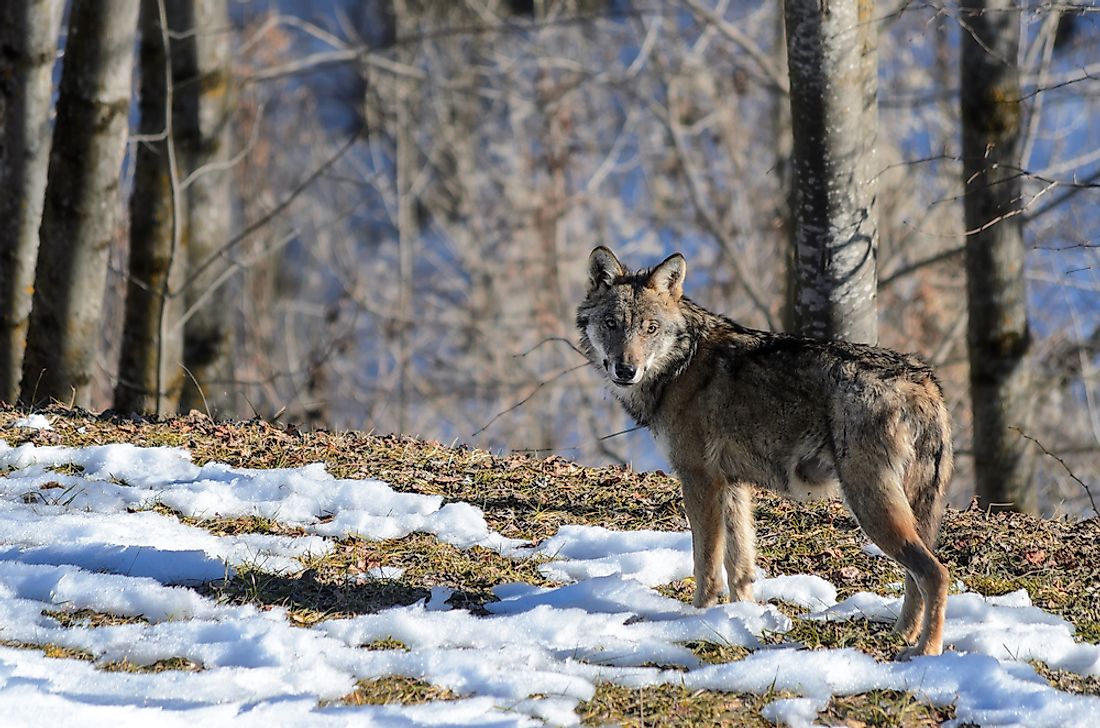
The Apennine wolf is confined to the most inaccessible areas of the Gran Sasso and the Monti della Laga.

The most imposing exponent of the fauna of the Gran Sasso is the Marsicano bear, a subspecies endemic to the Apennines, of relatively small size, which until a few years ago seemed to have disappeared, but was recently monitored in sporadic raids in the national park territories . 

Apennine fox and wolf specimens were also present. 

Other common mammals that live in the area are: the wild cat, the wild boar, the deer and the roe deer. 
The chamois has a reddish-brown coat with a dark dorsal line, from the throat to the anal mirror in white.

The apenine chamois had become extinct in the Gran Sasso (due to excessive hunting) around 1890, but it was reintroduced in 1992, and now forms a stable colony composed of more than 1,000 specimens. Among the birds of prey, it is worth mentioning the golden eagle, hawk, griffin, common hawk and hawk. 

The presence of the alpine bird and the woodpecker stand out among the other birds. Between the reptiles it is possible to mention the viper of Orsini, also endemic, smaller than the common viper and characterized by a less lethal and almost inoffensive poison, given the scarcity of sightings of this species. 

Placed in the rocks, close to the water courses and in the areas of low juniper avoid, as far as possible, contact with man.


The population of Rupicapra pyrenaica ornata present in Gran Sasso is estimated at 622 specimens (2015 census), and that of Majella is approximately the same size
Gran Sasso raid.
0
Previous PostOlder Posts
Mi Ping en TotalPing.com follow us in feedly